Tuesday, May 14, 2013

Memories of Silver

[This is the unedited version of an essay published in the Deccan Herald as Going, Going, Gone]


Memories of Silver

In a theme park near Bangalore, one of the attractions is a recreation of an 'old-time village theatre'. The box office is a rickety wooden shack with a tin signboard. There are faded posters of 90s movies with 'Coming Soon' hand-lettered on them. You cross all these, smiling, and enter into the actual 'theatre'. The best seats in the house are folding aluminum chairs, then there are several rows of backless wooden benches, and the cheapest seating area is just a sandy patch of ground. There are incandescent bulbs hanging from the ceiling, shaded by clay pots. The 'movie' is just a 10-minute long compilation of iconic scenes from old films (when I was there, they showed Gabbar Singh's introductory scene from Sholay). Inspired by the atmosphere, people around you clap and whistle at famous dialogues. You come out of screening feeling refreshed, feeling like you've just visited a simpler, more innocent time that has vanished forever.

Indeed, the way we watch movies has changed dramatically over the past few years. Leave aside the shift from watching one movie a week on Doordarshan, to having a dozen 24-hour-movie channels in your cable subscription. Forget the difference between having a couple of small video-cassette libraries in your neighbourhood, and of having the infinite resources of online shopping and the internet at your disposal. Take just the basic, most traditional, way of watching a movie by buying a ticket, sitting with a bunch of friends and strangers in a large hall and staring at a giant silver screen. Where once we had standalone, single-screen theatres with name like Alpana and Minerva and Rex, standing on independent plots of land, today we have shiny multiplexes, embedded into even larger malls, beckoning the young and peppy crowd. The multiplexes, while ostensibly in the same business as the single-screeners have changed every single part of the movie-going experience: from the way tickets are booked, to the seats, to the projection equipment - it's all new and 'improved'. But is it really a better way to be going about things? 

Take the way we decide which movie to watch. Once upon a time, the first we heard of an upcoming movie was by seeing its trailer before another movie. Or when we saw the posters in the lobby of the theatre. A week before it was due to release, the posters would spread out from the halls and onto every available public wall in town. If we were paying attention, we could hear songs from the movie on the radio. But it was possible for most of the movie to remain a secret. I still remember when Amitabh Bachchan's Shahenshah was released, it was not until after the release, when some classmates had seen it, that the rest of us heard the line 'Rishtey mein to hum tumhare baap lagte hai...". And we knew nothing of, say, the hot-air balloon scene or the courthouse scenes. We went to the theatre blind, relying on the superstar's allure.

Even after it was released, it was common for a good movie to take time to find its feet, to benefit from the slow spread of word-of-mouth. Sholay famously ran to empty theatres for a while before the word got out and the crowds started coming in. And the single-screen theatres were well suited to this kind of business: they worked on smaller margins, they had less staff. When a movie did do well, it could run for months or even years (we all know about the famous Maratha Mandir theatre in Mumbai, which has been running Dilwale Dulhaniya Le Jayenge continuously, for the past 17 years). Considering that the question to ask in those days was "Is there a movie releasing this week?" rather than "Which movies are releasing this week?" the model worked well. Almost every movie ran for more than a week, if not in the main shows, at least in the matinee and morning shows. It became a hit only when it completed 25, 50 or a 100 days.
That time is gone. Today, with the aid of multiplexes, a movie can be declared a hit and recover its money on the first weekend. A hundred shows run every day across all the multiplexes, mopping up all the demand quickly. Publicity departments for movies run at full steam to bring the audiences in as soon it's released. It's common to release details of the movie, interviews with the stars, have cross-promotion with television soap operas, sponsor TV shows and college events, even make up scandals and controversies just to get the movie in the public eye.

Take any recent blockbuster movie. We know all the lyrics of all the songs before it's released. We pretty much know what kind of story it is, and we know exactly what the leads will look like. We’ve read the trivia about the foreign shooting and the item song girl. We’ve seen the making-of interviews on the TV channels. What sort of revelation are we expecting in the theatre itself? And now that we're interested, we need to go see it on the opening weekend. The culture of long-running movies is gone; can you imagine even the biggest hits of today - Dabangg, Ra-One, Bodyguard, running in the multiplex longer than a month?
This is admittedly not the fault of the multiplexes alone; the very business model of movies is undergoing a change. But the frantic money-gathering around the first few days (which makes every movie a hit) is only enabled by multiplexes.

The rise of the multiplexes is killing not just the single-screen theatres themselves, but also any number of supporting businesses that grew up around them. Single-screen theatres tended to have a very basic selection of snacks (although everyone remembers with fondness the popcorn packets, the samosas in brown paper bags, and the crate of small Thums Ups - not to mention the rush at the counter during the interval). But just outside the theatre you invariably found several small snack vendors - a chaat wala, a bajji wala, fruit juice, soda and peanut sellers. Some of these vendors became well known in their own right. And medical shops, phone booths, even small restaurants were always available nearby, patronised by the crowds passing through the theatre.

The multiplexes, of course, have brought most of those businesses in-house. Selling eatables at sky-high prices is a model borrowed from US multiplexes, and it is the major source of revenue there. I'm not sure how much it contributes here, but the prices are definitely on the incredible side - a hundred rupees for a medium popcorn! Fifty plus for a sandwich! To make things worse, the "security check" at the entrance looks out for outside food with much more vigour than for bombs or weapons. It's even included in the pre-movie notice in some places: For your own safety we must check and remove all weapons, cameras, and outside food. Gone are the days when you could bring in a pack of glucose biscuits to avoid the interval-time rush.

Single-screen theatres in smaller towns outsourced even things like parking. This brings to mind a story my college professor was fond of telling. At the theatre he used to frequent, the bicycle parking was handled by local entrepreneurs who would rope off a segment of the pavement, leaving just enough gap for a cycle to enter or exit. They would then sell space in these improvised parking lots for movie-goers. (leaving your cycle outside these lots would mean a mysterious loss of air in its tyres). When my professor and his friends, in their college days, went to watch Dev Anand's Jewel Thief, they got a proposition from one of the entrepreneurs to park their cycles in his lot for 10 paise each. A competing lot owner then offered them the lower rate of 5 paise. Seeing his customers about to switch, the owner #1 tried to hold them to their word of honour. But finally, seeing them about to go to owner #2, he spat at them, "Fine, go! But let me tell you, Ashok Kumar is the Jewel Thief!"

Well, maybe bringing parking under the theatre's management wasn't such a bad idea. On the other hand, competition and outsourcing kept the prices of the food and the other facilities to the bare minimum. As each of these simple, low-end activities have been brought under the umbrella of the multiplex and turned into additional income sources, the average price of a movie outing has been rising. This includes, of course, the prices of the movie tickets themselves, but snacks/dinner, parking, and any number of extra attractions provided by the surrounding mall. Where an evening outing to the movies was something easily affordable by any class of people, today a movie for two, with dinner, could easily go above a thousand rupees. And if you're going on the weekend? Even more than that. Once a great leveller, movie watching has become an elite activity.

Beyond all these disappointments, what sticks in the mind is the boring homogeneity of the multiplexes. Once your ticket (printed by the same model of printer everywhere) has been torn and you step into the lobby, you could be in almost any multiplex in any town in India. It could be day or night. The food counters are always the same, the decor is the same colour shades, the walls displaying the posters look the same, even the security guards all wear the same sort of uniform everywhere. Where are the large lobbies with red carpets, the chandeliers, the paintings and distinct wall decor that marked each theatre differently? What about all the fancy type faces and metal letters announcing the name of the theatre, outlined in stark relief against the evening sky?

Many single-screen theatres that had been around for a while developed their own identities, for good or bad. Where this one was frequented by 'mill workers' and was best avoided by families, that one was grand and had a big lobby and air-conditioning and perfect for impressing out-of-town relatives. Other theatres stood out because of the genres of films they showed - in Bangalore, for example, Urvashi theatre near Lalbaug has been a hub for Tamil movies, and every Kamal Hassan release is accompanied by a gathering of his fan club there, putting up huge cutouts of the star. Rex, at the junction of Brigade Road, on the other hand, specializes in the latest English releases.  Theatres like these come into the common vocabulary of the local populace, become cultural icons. The Majestic area, after all, is named after the long-gone Majestic theatre. The distinctive outline of the Eros theatre in Mumbai has even been used as a backdrop in advertisements.

The upswing of the multiplexes has been steadily drawing business away from the single-screeners for the past two decades. As incomes rose, and more big-budget movies were released (both Indian and foreign), audiences were drawn towards the bright lights of the multiplexes which, let's face it, provided a cleaner, more assured experience, even if more expensive. The single-screeners began to be the second option - favoured by people with lower incomes, or who desperately wanted to see a movie and could not get a ticket in the multiplex. As time has gone by, many smaller single-screen theatres have gone bust, their land sold out to developers to build malls and apartments.

But all is not lost yet. Some hints at salvaging the situation come from the way US single-screen theatres have reinvented themselves - as specialists in specific genres, as hosts for film festivals, as showcases for vintage films, as nostaliga trips. There's no reason Indian theatres cannot do the same thing. Indeed, some venues are already doing it.

In Mumbai you have the Gaiety-Galaxy theatres which have been rebuilt as a set of 7 smaller screens. They're now becoming famous as the hangout for movie industry folks - they see a fair number of premieres, and even when normal shows are running, there are camouflaged visits from film stars and directors, to gauge audience reaction to the film.

In Bangalore we have the story of the erstwhile Symphony cinema, on M G Road. When it got closed down 'for renovation', the general sentiment was that it would get turned into another boring multipex. But it has become a luxury single-screener, with the spaciousness of the old-style space, and prices lower than other multiplexes - a new landmark. Then there's Rex, which is actually doing well just because of it's strategic location. With the large number of food stalls surrounding it, it has become a hangout spot for college students. Hopefully these trends continue, creating and updating these old landmarks with something new to look forward to.

To sum up, while the multiplexes are doing well and will not go away, there is still something to be got from the older single screen theatres - a trip down memory lane along with a pack of popcorn. Will you go on one this weekend?

Wednesday, May 08, 2013

Story Doctor: Ek Thi Daayan


Here comes the Story Doctor, to fix sick stories, show them the error of their ways, tell them what went wrong, prescribe a soothing twist or two, and send them off, healed and ready to hold audiences everywhere in thrall.

[Warning: This is not a review of Ek Thi Daayan. Rather, it is an analysis of the story. So don't read further unless (a) you've already seen the film, or know the entire story in intricate detail, and (b) fancy yourself a storyteller, like I do (or your wife calls you a baal ki khaal nikaalne wala). ]

First Impressions of the Patient


I'd been looking forward to Ek Thi Daayan for a long time. (After 13 B, this is probably the first horror movie that isn't a sleazefest.) So, went over the past weekend, and came back impressed enough to keep thinking about the movie.

The credentials of the movie are impressive - Vishal Bharadwaj and Gulzar on the soundtrack, an impeccably pedigreed first-timer, Kannan Iyer directing, an all-powerful female starcast, and the scene-stealer in Shanghai as the lead.

Overall, the movie lived up to part of the expectations - the soundtrack is generally awesome and worth looping, and the acting and direction is great. The very boldness of the concept- let's take a traditional Indian monster and update it to a modern urban context- puts the movie above other horror offerings lately.

But the promise held up by the story, particularly the first half, never quite gets fulfilled.  By the time it's over, you're conflicted about whether to like it or not. It's later in the night when you're trying to sleep and the Lautungi Main song and title sequence keeps playing through your head, that you realize that the movie has had an impact despite the shortcomings.(And of course you've kept the night light on tonight for no real reason.)

All the way up to the midpoint, things are going swimmingly. The device of using the hypnosis adds a layer of ambiguity to the flashback, and during the interval, we're all busy formulating theories about what is really going on. Lisa's introduction livens things up, and we seem to be heading for some major shock. And then, suddenly, the movie goes southwards. The last 'fight' comes straight out of a Ramsay brothers movie, and convenient last-minute world-building that gets thrown around ("Pishaach do tarah ke hotey hai!!!???") absolutely kills any subtlety left in the movie. Even the so-called Big Reveal - that Tamara was a Daayan all along - makes you yawn rather than be shocked. On top of that we have an absolutely cheesy penultimate scene at a outdoor grill that belongs to My Friend Ganesha rather than a horror movie.

Referring back to the Medical Textbooks

So does that mean that if only they'd directed the climax 'fight' better, the movie would have been a classic? I thought about that for a bit, and finally came to the conclusion that even the most slickly directed fight wouldn't have helped. The weakness was in the way the story itself panned out. There are more problems than one here, and several missed opportunities within the framework of the existing story. Let's go over these.

(a) A horror movie featuring monsters or otherwordly happenings can go one of two ways:
- The monsters are absolutely real in the world of the movie. You as a viewer know it early on, possibly some or more of the characters know it, and by the time the movie is done, everyone who matters knows it. We follow the characters as they too discover it, fight it, and either subdue it or fall before it. There are thousands of these movies, and I don't even need to give an example. Godzilla? Aliens? A Nightmare on Elm Street? Let's call these movies Type A. These movies are impressive either because the monster is unique, or the storyline unfolds in a good way.
- The second, more subtle type: There's some sort of suspense about what they really are and where they come from. We as the audience are given the viewpoint of one or more of the characters, who are under danger from the monster. We see the movie only through their biases and fears. Somewhere down the line, the later the better, we realize that the monster is not who or what we thought it was, and there's a shift in perspective. A few examples of this type are The Descent, Paranormal Activity, Identity, Kaun (with Urmila Matondkar) and Psycho. Let's call these Type B.

Now ETD starts out by being type 2 - we are seeing events undoubtedly through Bobo's eyes. When we're being set up for a flashback, we are first introduced to a doctor who will be more sympathetic with Bobo's viewpoint, and then the actual flashback happens through a hypnotism session - again, as the doctor says, this is something completely through Bobo's 11-year old eyes and hence not necessarily accurate. Most of all, the final scene in the flashback is open to interpretation (we'll come back to this in a bit). And for whatever reason, Bobo has forgotten enough about it to require external means of reminding himself of what happened.

What that means is that we're expecting some sudden revelation later on - that there was a trick of memory, that something hidden to us from the past will come out, that there is some actual suspense, in short.
       
But towards the end, the movie flips over and turns into a Type A - everything told to us so far was absolutely true, and the one guy who didn't believe it - the doctor - is forced into belief by the sudden appearance of Diana. We never know whether or not Tamara believes Bobo, so that point is moot. And further from there, the whole fight scene behaves as if the existence and nature of the monster had never been in doubt - when *that* should have been the big reveal.

(b) Continuing from above, if the movie was to have been a Type A from the beginning, we need the standard tropes related to that style: the disbelief of everyone else around the hero, the hero being conflicted and doubting himself, the signs that we the audience see that convince us the hero is right, and finally the one-by-one convincing of the necessary characters to force a showdown. Not a single one of these happens.

(c) While the mythology of the Daayan herself comes through fine, the whole Pishaach addition is done almost as an afterthought - as if the writer couldn't think of a better way to end the movie, and relapsed into Twilight "Saga" mode. The so-called plot twist - which is that the one person built up to be trustworthy (Tamara) was the villain, and the doubtful person (Lisa) was actually good, is so old that people probably groaned when it happened in the Bible. It's not that you can't see it coming, it's that it's so boring that you don't care when it happens. Even worse, what was that Ramsay style sacrifice to Shaitan bullshit? These supernatural creatures are going to stand in a circle like normal people and chant? Who thought this was a good idea? And the final fight was even worse than Ramsay - these creatures can turn into lizards, or disappear, or god knows what else, and they're slugging it out like a WWF match, in full lighting? We needed a more interesting, or alteast competent, ending.

(d) And finally, that song. That Totey Udd Gaye song. WHY IS IT EVEN THERE? Worse, WHY IS THERE A MUSIC VIDEO AROUND IT? What happened to the repurcussions of that lengthy flashback just before the interval? Who edited this movie, anyway?

Fixing all the above would really mean making a movie with a completely different ending. Since, as you can see above, I see it heading in a Type B direction till some way in, let me propose an alternate resolution that goes all the way.

Preventive Measures

If we had to choose a point where the story goes south, it would be the point where it turns from Type B to Type A. That's the scene where Diana appears, exactly as she was in the flashback, to the doctor, and kills him. So we'll have a brand-new story from then onwards. Even before that scene, though, let's make a few additions and changes:


1. Even before Bobo became an orphan, he was fascinated by the orphanage next door, when Zubin lives in the current day. When his family died (or disappeared in the case of Diana), he did get taken in my some relative, but he kept running down to the orphanage and to the closed flat, staring at it from the street, where he would sometimes see Diana or Misha through the windows, calling to him. In spite of that, he did go into the flat from time to time, drawn by his memories. This explains why they wanted to adopt Zubin from that orphanage.

1.5 Before the eclipse/hide-n-seek scene, something breaks in their house, in the hall - a water pipe or maybe a concealed wire. Workmen were fixing it, and Bobo watched them with great interest.

2. When Bobo would go into the flat as an adult, one of the things he does is to stare at the photo of his sister on the mantelpiece.

3. Tamara hears the whole story about Bobo's family's death, and it devastated by it. She gains further sympathy for him, but there's a leery edge, as if she doesn't quite believe that there was anything supernatural about it. There's an intense scene where Bobo convinces her that it was all true for him. And no matter what, it ended with him losing his family, so isn't that what matters?

4. When Lisa comes into the flat to buy it, she stops and stares at the photo as well. There's some comment to the effect of "you miss your family a lot, huh, Bobo?"

5. Tamara tells Lisa about Bobo's back story to some extent. In particular, she mentions the Lisa Dutt name that has haunted Bobo for some reason. We change the scene of Bobo googling for that name, to Lisa doing it, and then hunting for photos of the time. She doessn't find anything, but it's clear she makes something of it too.

Corrective Medicine

And now, starting from just before the attack on the doctor:

The doctor picks out the old leather book again, after many years, and flips through it. He sees something there, breaks out into a sweat, and decides to call up Tamara. He tells her they are in danger, and to get out of the house immediately. The two of them try calling up Bobo, but he does not answer.

Someone attacks the doctor just then and he dies of shock.

Lisa arrives at Bobo's house, and tells Tamara/Zubin that Bobo is in trouble, and to come with them. They go with her (cue hidden, ambiguous, smile by Lisa).

Bobo reaches home, finds no one there. He has been suspecting Lisa all along, so he decides that she has kidnapped them, and decides to go to her (his old) house.

Tamara and Zubin are nonplussed when Lisa takes them to her home and there's no Bobo around. They remember what Bobo had been telling them about her, and panic. Lisa asks them to hear her out.

Bobo arrives at the building, and again sees Diana and Misha in the windows, calling to him. He starts to rush up, but is stopped by a lizard on the way. Then he sees Diana in her Daayan form, stopping him from going up.

Lisa asks them what Bobo told them about the fateful night, and they tell her. She shakes her head sadly, and then tells them to take the same thing and interpret it as an adult. Misha died of suffocation in the trunk - Bobo's fault for putting her there. Diana went in the room, and could not open the trunk in time. She was screaming in shock and pain (Bobo interpreted this as a daayan's scream). Pavan saw the body, blamed his wife for the death, and she yelled, denying it, and he had a heart attack and died. Bobo is sitting there, lost in his guilt, unable to understand what was happening, and blamed the 'Daayan'. He picked up the knife and stabbed her in the back.

Flashback ends. Tamara and Zubin are in shock. Finally, Tamara asks, if that was the case, where was her body? When the police came there, there was only Misha and Pavan. Lisa smiles sadly, and gestures to them to follow her. In the place where the pipe/wire had burst and wall had been dug up and replastered, the wall has been dug into again with a pickaxe. I looked all over the house, and finaly found it here, Lisa says. A skeleton hand - still with a ring on it - is poking out of the broken wall. If we can swing it, this is close to the mantelpiece where Misha's photo is - Bobo has been drawn to the spot where he hid the body, he wasn't just looking at the photo.

Flashback to Bobo, panicking, guilty, right after the murder. No one has heard anything of the screaming, fortunately. He drags Diana's body over to the hole, and begins to plaster over the wall badly. Then he throws a sheet over the wall and drags the trunk there. A crazy smile on his lips.

Tamara is confused. Why are you concerned about all this, she asks Lisa. Another flashback. Diana implicated in a crime she did not commit - her name actually was Lisa. She left her daughter in the care of a relative, promising to make a new life somewhere and then take her with her. Arrived in Bobo's town, had an affair, fell in lovei with Pavan. Wrote a last letter saying that she had found a papa and a brother and sisters for daugher (daughter is of course 'Lisa' of the present day), and then - no more letters - no more news. Enquiries made by relatives returned saying she was a con woman who fled with money after killing the family. Daughter did not believe it, and waited until she could come here to find out the truth.

Bobo has heard the last part of this. He walks into the room, and see Lisa, Tamara and Zubin all as daayans and pishaaches. It is clear that his mind was basically warped from reading that book in his childhood. He says, you all are daayans, out to get me, but I won't let you. That doctor was one too. Flashback to the doctor finding child Bobo's handwriting in the book, possibly with pictures of Diana stuck into the drawings there, and demented ravings, just before Bobo arrived there to kill him.

Bobo attacks the three of them, raving about cutting their hair. Tamara gets behind him in the struggle and knocks him on the head. Depending on how the story works best, Tamara either dies or is seriously injured.

Final scene, Bobo locked up in a psychiatric ward. A nurse arrives to check on him. He sees her as a daayan, with those large eyes, and cowers in fright. DO NOT show any ambiguity about the nurse being a real Daayan or anything extra at this point, unless you want to be like a crappy 80s movie.


Treatment Successful


The Story Doctor will return! 


Tuesday, January 08, 2013

The so-so son returns

A chance search through the blog to dig up an old post brought home the fact that I haven't updated it in more than a year. This is depressing in many ways.

Lots of things have happened since the days of regular updates. I'd always intended for this place to be a dumping ground for thoughts, and a place for fiction experiments. Somewhere along the line, the latter coalesced into a novel-in-progress, which was kept away from the blog. The former exercise was rerouted into paid reviews and articles for newspapers and magazines, which still continue.

Well, the novel-in-progress is in limbo now, with motivation and time hard to find. And the beginner's joy of getting paid for writing is replaced by the grimness of a side-job (although still providing me with a sense of self-worth). Which means this experimental space has a place again in my life.

The literary scene too has changed over the years. Or maybe I've changed and figured out some of the things I was doing wrong? Working in a corner secretively accumulating words for a big bang doesn't work unless you're very very used to it already. The only way to get used to it is to set smaller targets, provoke the muse and share her rewards with friends and strangers. Write more, write frequently. Write without a mindblock of "Am I getting paid for this?" and you'll write better. Here goes.

And so, it's back to the regularly scheduled program of brain farts here on this blog. It's good to be back in the workshop. Dusts the lathe off.

Tuesday, February 22, 2011

An Entire Stadium Disappears

Let me start by saying: I'm not especially interested in cricket, and will probably heave a sigh of relief once the World Cup and the IPL are done with. What interest I do have is because of my wife, who follows it like a true fan. We even went to Chinnaswamy Stadium for a couple of the practice matches there before the World Cup started proper.

And so we were happy when we found that an important match, India Vs. England, was being shifted from Kolkata to Bengaluru. Immediately the missus wanted to be try and get tickets. Knowing that over 50% of the city would want to attend (and the other half would be dragged there by their spouses), I looked around the net for the sales venues so we could be there on the first day. This was about two weeks ago, and the websites, and the news outlets, and signs at the stadium itself, all said that the tickets would be on sale starting from the 21st of February. Just 6 days before the match itself? Weird, but... OK, we'll go then.

A week after that, around Valentine's Day, there's this strategically inserted news item that talks of how the folks who bought tickets in Kolkata for the match originally are getting their corresponding tickets for Bengaluru. Wait, what? Are they all going to fly down all the way to see the match? At the most, this would be 5 to 10% of the total ticket holders.

A couple of days after that, on steady enquiries everywhere, it seemed like Planet M, Reebok (Official Partners Of The World Cup apparently) will sell the tickets offline, while Kyazoonga will sell the tickets online.

On the 20th, when we called up Planet M to confirm whether they're selling tickets, they backed out - they weren't going to be selling them any more. Oh well. On the night of the 20th, I stayed awake, hoping that "21st" would be taken literally and I would be able to buy the tickets online after midnight. No such luck - in fact the site got overwhelmed by the masses of people like me who had also hoped the same, and it got knocked offline for most of the day after.

Today (the 22nd), two things happened. There was a news story about Kyazoonga, which apologized for going under, and also mentioned that it had only 4,500 tickets for the finals anyway. There was no mention of how many tickets it had for the Bengaluru match - it would have to be less than the Finals, of course, so we can set 4,500 as the upper limit.

The other thing that happened was that we got a call from Reebok (Official Partners Of The World Cup), telling us that since we're earlier registered as being interested in the tickets, it was their duty to inform us that Reebok would not be selling the tickets for the match. The only offline place to get the tickets now was the stadium itself, and that too would probably begin only from the 24th, or thereabouts. As it was, "there were very few tickets left", and that was why Reebok outlets were not getting tickets to sell.

Recap: Online tickets are a very small number. Almost every outlet that was due to sell the offline tickets won't be doing so. And since there's an unknown but apparently significant number of people flying down from Kolkata, no one knows exactly how many tickets were supposed to be there. But "There are very few tickets left".

WHERE is this stadiums-worth of tickets going, then? The only other news story about this match was about MPs and corporators armtwisting the stadium officials into giving them large numbers of tickets. Could that be it? When we'd gone to the stadium for the practice matches, we were lucky to get tickets - apparently they'd all been bought by black marketers who were selling the same tickets for double the prices. Could it be the same back-office arrangements being made on the sly for the upcoming match?

Whatever - the missus threw up her hands in disgust and decided that it was not worth it. It was never going to be a fair fight/queue/arrangement, and any and everyone who could use his jugaad to get the tickets would be doing it anyway. So now we're watching the match on TV. Hope the cable guy doesn't decide to charge us extra for it.

The whole thing just makes me feel helpless. Whether it's buying a ticket, a house, land, food, phone - the moment any government body touches it, it's like the kiss of death for fairness. All I'm doing is sitting here angrily typing into a computer, I know, but no one else cares, in any case. They're too busy finding contacts to get their work done.


Wednesday, February 02, 2011

Introducing Tender Leaves

[Here's what I've been up to for the last few months. Pliss to pass on to your Pune based friends.]


Tender Leaves

It’s more than just a library

Introducing Tender Leaves – a unique book rental service that delivers books to your offices. What’s more - you can read at your own pace. There are no due dates, no late fees.


Books for You. Delivered to You.


Hand-picked recommendations and must-read lists to help you choose from thousands of books in English and Telugu across 43 categories. Based on your wishlist, books will be delivered at your office, Monday to Friday. When you are done reading, you can return the books by dropping them in the drop-box at your office. As soon as your books are received, your next shipment of books gets automatically scheduled.


With a combined experience of over 20 years, the founders B V Harish Kumar and Sudarshan Purohit have worked in IT companies like Persistent Systems, Infosys, BMC Software and Intuit. Sudarshan has also translated Hindi pulp fiction novels into English. Their passion for books brought them together.


Libraries were never so convenient and cool
  • Free Delivery of books all over Pune
  • No Due Dates. No Late Fees
  • Thousands of books in English and Telugu (Hindi, Marathi and Bengali coming soon)
  • Reviews and Ratings to help you choose books
  • Win badges and goodies for reading
  • Choose a subscription plan that suits you best
  • Plans starting at Rs. 200/- per month. Attractive discounts on half-yearly and annual plans.
  • Secure online payment using CCAvenue – India’s leading payment gateway. Or pay by cheque.
So, what are you waiting for? Sign up Now!

P.S. Do remember to use the promo code FIRST100 to avail a discount of Rs. 400/- on all half-yearly and annual plans.


Saturday, July 03, 2010

Skimming the Surface

[This review of Dreaming in Hindi, by Katherine Russell Rich, was published with some edits in the Deccan Herald]


Sometime in 2001, Katherine Russell Rich decided to learn a new language. In fact, she decided to leave New York, go to the country where it was spoken and do a year-long course there to learn it. The language was Hindi, and the country was India. This book is partly a chronicle of that one year in India, and partly an exploration of what it feels like to learn a new language.

The book runs on four tracks simultaneously: Her experiences in India; discussions on the Hindi language itself; her views on Indian culture, religion, and so on; and finally, the neurology of learning a language, as understood from several researchers in the domain.

Of these four tracks, the last one is the most successful. Rich’s core theory is that learning a new language changes the way the brain itself works, and probably shapes the way experiences are stored in the brain. She interviews several experts (all of them American) about the latest findings, and explains their theories. At one point she uses the various flavours of sign language – American, Indian, formally structured and informally developed – to explain how the cadence of a language influences communication itself. These are the most interesting parts of the book; these topics have not been covered enough in popular writing, and Rich has created a good overview of the field here. Moreover, the discussion often goes way beyond Hindi itself, into what learning any new language is like, so there is plenty of interest here for Hindi-speaking readers too.

Unfortunately, the other three topics covered by the book fall flat. These sections are written with a very specific reader in mind: a monolingual person who thinks of India as an exotic land of turbaned, old-world maharajas. Neither of these criteria matches the typical English-speaking Indian reader, who speaks at least two languages and thinks of maharajas as belonging to mythological serials on TV.
Rich’s year in India was spent almost entirely in Udaipur, which is described in loving detail, exoticized the way the tourists like it: She lives in havelis, walks past cows on the street, meets traditional housewives who never completed school. And yes, meets the requisite Maharanas. Udaipur, however, is not equivalent to India, and Mewari-accented Hindi is definitely not the only language spoken in the country. So sentences like these jar: "In India, time is circular, a perception that’s shaped by the concept of reincarnation… yesterday and tomorrow are the same word: kal. 'The day before yesterday' and 'the day after tomorrow' are both parson... All the days in the spin are the same: aaj. In the west, in contrast, in English, time is linear..." What about the hundreds of other Indian languages with different words for "yesterday" and "tomorrow"?

At times, Rich attempts the near-impossible task of explaining India to the western reader from her Udaipur vantage point. When she opens up a newspaper, the paper invariably mentions some significant event, such as Godhra, or the Babri Masjid destruction and the resulting riots. A colleague’s idle comment is linked to the massacres on trains during partition. All these incidents are pithily explained away, blame squarely placed, history turned into bite-sized chunks, definitely not intended to give the complete, complex picture.

Then there’s the required quota of exotic-India words, stuffed in at the first possible opportunity: tigers and saffron and saris. In the first chapter of this book, Rich sees a hotel swimming pool, and describes it thus: "The pool was mango-shaped."

The overall form of the book causes a few problems as well. Because she’s using her experiences during her course as the springboard for the scientific theories, Rich needs to shoehorn in some incidents that roughly match the topics of the theories she plans to talk about. So random comments by acquaintances lead Rich to talk about the latest views on Chomsky’s papers, and an invitation to a deaf school leads to a discussion on the "spreading activation network theory". This sometimes works, and sometimes doesn’t. Also, since we know she did a specific course in India and then came back, there’s no ending or climax to build up. Rich ends her chapters with cliffhangers like "…and now I would be the next one to go down", which don’t really turn the book into a page-turner.

Rich winds up talking of too many things at once, and perhaps because of this, never really goes deep into any of them. The neuroscience sections are probably the only ones that feel authentic, and it would have been a good idea to have an Indian look through the culture sections for glaring errors (The definition of saala given actually means jija in Hindi – the problem probably happened because both words mean brother-in-law in English). But, as mentioned above, the book isn’t written for Indians at all. It is definitely not a guidebook to India, nor does it help in any way in learning Hindi. No, the book is about an American woman’s jaunt to an exotic country, and her subsequent interviews with researchers back home.

Tuesday, June 01, 2010

Some rudimentary water-related calculations

I posted this status on Facebook the other day: "If you take the number of centimeters of rain that fall on Bangalore or Pune every year, multiply by the land area, and divide by the population, you get so much water per person that we should all have enough and more of it every day.
(This is what I've been doing today afternoon, aided by the numbers from Wikipedia)"

A couple of folks wanted me to post the calculations, so here's a post explaining it.

According to this site, one cubic metre of water is equivalent to 1000 litres. So, if your city has an area of one square meter (small city, I know), and it has one meter of rainfall in a year, the city is getting a thousand litres of water. I.e., one centimetre of rainfall over one square metre is 10 litres of water.

Wikipedia lists Bangalore as having an area of 710 sq. km. approximately. 1 sq. km. is about 10^6 square metres. Therefore, if one centimetre of rains falls on Bangalore, we have 10 litres * 710 * 10^6 of water. That's 710,00,00,000 or 710 crore litres of water.

The official government site on Karnataka lists Bangalore as having about 900 mm of annual rainfall, or about 90 cm. That means that about 63,900 crore litres of water falls to the ground within Bangalore city limits every year.

Again, Wikipedia lists Bangalore's population at 65 lakhs. 63,900 crore (i.e. 63,90,000 lakhs) divided by 65 lakhs is 98,307 litres of water per person per year. In other words, about 270 litres per day.

This set of statistics show that only about 9 developed countries show a water use of more than 270 litres per day. India is way down the list, at 150 litres or so.

What it all boils down to (pardon the pun), is that if Bangalore can hold on to all the water that falls in its own territory every year, every citizen will have all the water he or she needs for every purpose. I haven't even considered all the water from the Kaveri river schemes and so on, and the much lower population density of non-urban areas in Karnataka.

Just hold on to the rain - using lakes, by letting the earth absorb the water, by helping the water table rise, and you will solve your water problem for a very, very long time.

[This is a rather naive calculation, I know, but the overall logic sounds pretty fair to me. Try it for your own city]

Friday, May 28, 2010

A fun thriller inspired by headlines

[This is the unedited version of a review published in the Deccan Herald]

Fun Thriller

[ Review of Blowback, by Mukul Deva]

Early on in Blowback, a mysterious tribal leader assembles all of the tribes fighting for jihad and outlines a radical plan to them. They listen, awestruck by the brutality and originality of the plan, and elect him as their leader. A few months later, the plan is put into action. You the reader wait to see what dastardly ideas the terrorists have. And it turns out that they’re... putting bombs in crowded places in Indian cities. Yes, it is brutal and effective, but your average Indian reader is bound to find this revelation a bit anti-climactic. We know this is happening today, and, due to the hard work of our investigative agencies, we also know some part of the planning. Reading about almost exactly the same thing in a thriller makes it seem like some sort of investigative journalism. Where are the devastating nuclear bombs, the almost-unbelievable terror plots, the top-secret biological weapons?

Once this bit of disappointment is digested, though, the book grows on you. After all, some of the terror attacks of recent times would have been unbelievable a few years back. Some of Frederick Forsyth’s writing doesn’t seem quite so comfortably imaginary any more. Deva’s writing could be looked at as something closer to real life, immediate, something really plausible and right-out-of-the-headlines. The writing style adds its impact – Deva’s big strength is the smoothness of his prose, crisp and fast-moving, and you never get distracted from the story by the writing. It all feels like a good piece of reportage rather than an action thriller.

In addition, the main protagonists are generally well drawn and plausible, if slightly larger-than-life. The different people in Force 22, the elite unit around which the events of this book (and Deva’s previous two books, Lashkar and Salim Must Die) revolve, feel well etched out, with their individual weaknesses, passions, and history, and some of them evolve through the book.

If the character development fails anywhere, it is in the bad guys. Without an exception, all are totally evil and monomaniacal – no trace of doubt and no understandable motivation for their viewpoints. You could substitute the low-level terrorist recruits with the tribal leader mentioned above with no difference to how the story would proceed. The best action thrillers take the time to show how the villains got where they are, and what the world looks like from their viewpoint – this book doesn’t.

Unfortunately, there are a few segments where the storytelling isn’t up to par. The ending takes on a Bollywoodish touch, with true love, maa-ki-mamta (mother’s love) and tragedy taking over the proceedings instead of the expected riveting action sequence, leaving a bit of an off-taste for the reader. Another weak segment is a several-page-long discussion between senior Indian officials and the Prime Minister about the growth of terrorism. Deva uses this scene to list all of his ideas to solve the problem, one after the other, ending the sequence with the comment that things will now improve since the Prime Minister’s heard these ideas. Any smart editor would have cut this sequence, since it is nothing more than a tirade by the author.

Overall, the book succeeds at being a fast-paced, entertaining, genre thriller, in the vein of works by dozens of other western writers. Just like those other books, though, it also disappears from your head after you’re finished, leaving no real impact on you.

Monday, April 12, 2010

The Adventure of the Name-dropper

[The following review of Holmes of the Raj appeared, with some edits, in the Deccan Herald]


Holmes of the Raj, by Vithal Rajan

You have to say this about Vithal Rajan – he gets the language down pat. For anyone who’s been a fan of Arthur Conan Doyle’s stories of Sherlock Holmes, and can’t get enough of Doyle’s crisp narration, reading Holmes of the Raj will be nostalgic. The book consists of 6 stories of Sherlock Holmes, chronicling an extended visit to British-era India, narrated by the sturdy Dr. Watson, using very similar language to the original.

The language, however, is where the similarities end. It’s fun to read about Holmes travelling to all the popular spots in Raj-era India – Madras, Nainital, Calcutta – but, well, he doesn’t seem to be doing all that much. The core of the Holmes stories are always murders that are just not possible, incredible-sounding mysteries, and in general, puzzles that make us go “Ah!” once we understand the answers. Holmes doesn’t get into any such thing here. At most he’s traipsing through Central India looking for a tribal deity, figuring out a smuggling ring, or stumbling across Jack the Ripper while looking for something else. Where are the speckled bands, the dancing men, the curious incidents of dogs in the night-time? The stories here would have fit on Allan Quatermain or The Saint or maybe even Fleming’s James Bond – any heroic British character, in fact.

More than the locations, Rajan relies on references to real-life and fictional characters from the era to set in the book in the Raj. Unfortunately, there’s rather too many of these. There are no less than 64 entries in the appendix of Holmes of the Raj, most of them about the real-life people referenced in it. This doesn’t include the dozen or so fictional characters referenced. Considering that the book is 260 pages long, that comes to about one reference every three pages. And these references go all over: Dhyan Chand, Motilal Nehru, Ronald Ross, Kim, Clark Gable, Madam Blavatsky, even Balraj and Parikshit Sahni. It’s as if Rajan was attempting to stuff in as many names as he could think of. And there’s no subtlety about it, each character is named and described and given his dialogues, so you never have to make any effort to spot them, which is no fun.

In addition, Holmes and Watson sometimes seem like the aliens from 2001: A Space Odyssey, teaching the natives all sorts of things that they couldn’t have thought of themselves – how malaria is actually spread, how to bowl the doosra, how Rabindranath Tagore should begin his famous poem. More focus on the mysteries themselves, and less on all these clever hints about India, would have made it worthwhile.

To his credit, Rajan has done a lot of reading on the topic. His descriptions of the railway systems, of the British dwellings of the day, and so on are meticulous and detailed, and the stories use these things as integral elements. The characters making cameo appearances often expound upon their points of view about British Rule and India, and assuming these are historically correct, the book serves as an interesting reference about who said what. And, as mentioned before, the language is very close to Doyle’s language.

But it takes a special kind of writer to create convoluted murder mysteries – to imagine strange circumstances, to think up clues and red herrings, to model the murderer’s and the detective’s mind, and Rajan simply does not belong to that class.

Read this book as an interesting journey through the Raj as narrated by a familiar voice, but not as a series of detective stories.

Wednesday, April 07, 2010

A Shelf-full of Books

[The following piece appeared, with some edits and a title change, in DNA on the 21st of March]

A few days after my first translation, The 65 Lakh Heist, by Surender Mohan Pathak, was released, I walked into a large chain bookstore to see if it was stocked there. I found it in the “Indian Fiction” bookshelf. Its two closest neighbours were an anthology of Love stories edited by Ruskin Bond, and the newest book by Salman Rushdie.

I’ve been browsing through bookstores all my life, but it wasn’t until then that it struck me just how unfair the categorization was for all of the books displayed in the Indian Fiction category. The Ruskin Bond book should have been under Romance, or maybe under Anthologies. Rushdie’s book should have been Literary Fiction. Many of the other books felt wrong, too – Tagore’s and Premchand’s translations should have been under Classics. There should’ve been some sort of category created for Indian campus-lit and chick-lit by now, but those books sit next to historical thrillers and post-modern fiction in the same Indian Fiction bookshelf.

The reader will, no doubt, point out that the volume of Indian books in all these genres is so low, that the books would be lost if mixed in with the other – non-Indian – books. And starting from that point, the reader – and several writers and reporters – have come to the conclusion that Indian writing is very limited and that readers here read much less than their counterparts in other countries. Although this makes for great copy, it’s far from the truth.

Let’s go back to that book I talked about in the beginning – The 65 Lakh Heist, by Surender Mohan Pathak. Mr. Pathak writes crime thrillers in Hindi, and has so far written 270 of them, selling over 25 million copies of his books. The 65 Lakh Heist alone has sold over 3 lakh copies in Hindi. Hindi Pocket Books, as they are called, are a huge industry – but no less than Marathi, Tamil, Gujarati, or Bengali popular fiction. This is hardly surprising. The number of people speaking these languages in India is more than those for whom English is a first language. And this industry publishes books in all genres – romance, action, thrillers, noir, social dramas, literary and historical fiction. And if you look at Indian publishing as a whole, instead of just the English segment, it’s thriving and can give English-language publishing in, say, the US, a run for its money.

But if this industry is so large, why are the books in the Indian languages not stocked in the “prestigious” chain bookstores in India? In Bangalore, chain stores have an emaciated-looking Kannada shelf which features Kannada translations of “Chicken Soup for the Soul”; in Pune, there’s a Marathi shelf which contains (you guessed it) Marathi translations of “Chicken Soup for the Soul” and “The Alchemist”. The Hindi shelf, if present, has the same content. Why do the stores boast variety in the English section but turn the Indian language shelves into pale echoes of the English shelf?

I spoke to Krishnakumar R., of Odyssey, about why there weren't more regional language books in Odyssey stores, and he listed three reasons. "The publication schedules of regional publishers are not well planned and have less volume than the English publishers. Second, the distributors of these books don't do a good job of pushing these books to our stores, so we don't get the books reliably. And thirdly, economics is a factor too - our profit margin on regional language books is definitely less than the English books."

All of which are potential discouraging factors, true. But then these stores already deal with a wide variety of products: music, movies, weekly magazines, stuffed toys, show pieces, and so on. Many of these will have the same problems that Mr. Krishnakumar listed. Most tellingly, though, he states, “And we also need to stock those products that cater to our target class of people.”
Perhaps that’s the crux of the issue – the perception that popular fiction in regional languages is a different class of people from those that read English. The feeling is that there are different stores for those books anyway, and the people who come here prefer only the English books.

The movie shelves of these same stores prove them wrong. In the past few years, the size of the Marathi, Kannada, Bengali, and whatnot shelves has grown dramatically – everything other than Hindi and English used to be on one shelf, and now they occupy a fourth of the movies section. And there’s always a crowd sorting through them. Everything that could be said about regional language books could be said about the movies, too. Yet, the stores cater – profitably – to every type of Indian movie watcher. If they actually stocked a representative collection of popular fiction in Indian languages, the stores would similarly attract the general Indian reader, instead of focusing on the niche.

We the English readers, though, us fans of Chetan Bhagat and Dan Brown, would find ourselves in trouble if this happens - we wouldn’t know what to buy. Not because we’re ashamed to, but because we simply don’t know which books are good, and which are tripe. We know when the newest John Grisham is coming out, but we don’t even know which writers are good in Hindi. How is it that we, readers of this paper, never hear of the new releases in Hindi/Marathi/Tamil ? Why are there no best seller lists or reviews we can refer to?

Well, yes, the Hindi/Marathi/Tamil newspapers do talk of these books, and they do have a good circulation. So it could be argued that English newspapers don’t “need” to cover them. But the reason to cover regional literature is the same reason that Bollywood and other Indian cinema is covered in the English media – it is interesting to a large part of the population, it is a large industry that involves thousands of people and large amounts of money, and it is as much a part of the popular culture as movies are. It’s strange that cinema is covered and fiction isn’t.

We might be in this situation because we’ve imported the whole business of English books – writing, buying, marketing, even the genre names on the bookshelves, from the Western books ecosystem. This includes the reviewing and the top ten lists and the contacts with the press – everything that constitutes the hype that sells the books. Publishers in other languages are still waking up to the fact that the English publishing industry is dominating the literary supplements with its flashy covers and advertisements. Writers in other languages are much more grounded – they aren’t turned into celebrities the way English writers are, and they have traditionally depended on word of mouth for their publicity.

Some Indian language book publishers are now learning from their multinational counterparts – they have websites, push for reviews, and even make extracts of new releases available for new readers. A couple of English newspapers now carry columns by writers in other languages. The translation market is booming – until now, it was lop sided, with books from all over available in other Indian languages, but next to nothing available from Indian languages in English. This has changed over the past couple of years, with more and more interesting titles coming out, and more publishers jumping into the fray. Almost every genre of books is now getting translated, raising interest in the originals in their respective languages.

Maybe in a few years, we’ll be as informed about the latest releases in Kannada or Hindi or Marathi as the English ones. And we can go to the chain book stores, and buy our own writers from the genre shelf that they belong to – not the ‘Indian Fiction’ bookshelf.


-------------

What to start reading
If you’re interested in reading some popular fiction from around India, but aren’t familiar with the languages required, here’s a list of new and interesting translations into English.

1. The Blaft Anthology of Tamil Pulp Fiction: This was probably the book that started the current wave of interest in popular fiction. Excellently produced, smoothly translated, this book is a must-have.
2. Chandrakanta, by Devkinandan Khatri: The original isn't contemporary, in fact, it's nearly a century old now. But a recent translation, by Puffin books, was quite well done, and probably is one of the few of Indian fantasy so far.
3. The Adventures of Amir Hamza, and Tilism-e-Hoshruba: These are very interesting popular epics, in Urdu and Persian, which have been embellished through the centuries by storytellers. Excellent translations by Musharraf Ali Farooqui came out last year, which revealed these stories for the first time to English readers.
4. The Feast, and other visions of malevolence: This is an interesting graphic novel adaption of weird tales("goodh katha") by the renowned Marathi writer, Ratnakar Matkari. It is scheduled to be released this year, and it will be the first translation of this genre into English.
5. House of Fear, by Ibn-e-Safi: Random House recently released this translation of the cult Urdu pulp writer Ibn-e-Safi, detective stories. There is another anthology of his work, Doctor Dread, coming out soon from Blaft publications.
6. Faster Fene: B.R. Bhagwat created this young lad who gets embroiled in adventures and mysteries with alarming frequency. He's been a favourite of Marathi readers for decades now. Some of his stories have been translated into English, too, but are available only in stores in Mumbai/Pune.
7. Byomkesh Bakshi: Made famous by the TV serial starring Rajit Kapoor, Bengali readers have long been fans of this detective. Sreejata Guha has recently been translating them into English to bring the stories to a wider audience.
8. The 65 Lakh Heist, and Daylight Robbery, by Surender Mohan Pathak. Blaft published these translations of the bestselling Hindi crime writer. These are books starring his popular anti-hero, Vimal, who is reluctantly conscripted into criminal capers.

Sunday, February 28, 2010

Anarchist's Agenda

[An edited version of this article appeared in the Deccan Herald on the 14th of February.]

Anarchist’s Agenda

(Review of The Diary Of An Unreasonable Man, by Madhav Mathur)

There’s a certain kind of urban, salaried young man who will instantly understand Madhav Mathur’s message in this book. The man who’s working a white-collar job, finding that the moral compromises he makes in the course of work weren’t on any syllabus in college. Who is beginning to get tired of the rat race for the new car, the new flat and whatever else everyone else wants.

For this reader, Mathur offers a thought-experiment: What if you stopped being part of the system, and instead decided to take on the people taking advantage of it? And what’s more, what if you actually went through with all those vaguely imagined pranks you’ve always thought would serve the villains right? And what if all those prankish plans executed perfectly, and people understood what you were trying to say and made you a folk hero?

The story stars Pranav Kumar, an advertising executive, whose normal state of mind is ‘sickened by hypocrisy’. After several years of working at writing advertising copy, he finally confesses to his boss that he can’t keep doing this job. Advertisers, he says, are the root of all the materialistic rot in society: “We’re building wants. We’re making an entire generation adopt cellphones and motorbikes as their goals. We’re to blame for discontentment. If we don’t get them through television, we always have papers, magazines, and billboards…”

Pranav quits his job and, together with two friends, decides to shock people into realizing the mess that society is in. The story chronicles all their “prove-the-point” practical jokes. For example: they bring over toxic sludge from a chemical factory and use it to prove that the factory owner was hand in glove with the Pollution Control Board. Or use a paint bomb in a local train to remind commuters that life is precious. Or expose all the regulars at a brothel to society.

What exactly Pranav wants to prove with his jokes is not exactly clear – the targets are all over the place, but one can imagine Mathur, at some point, daydreaming of them and going, “It would be so cool if someone did that!” The most consistent message, of course, is the anti-materialism one. Without this message, the book is just a series of practical jokes played on people and practices everyone loves to hate – industrialists, prostitutes’ customers, salesmen, fashion designers. It’s the message that gives some form to the book. In some ways, this is similar to the work of Chuck Palahniuk. But where Palahniuk takes one or two sentences to express his pop-cultural, cynical sentiments, Mathur fills up half a page with clunky ponderings. His forte is the action scenes, not all the philosophy and dialogue.

In fact, one can imagine Mathur playing the scenes in his head and putting them down on paper, the action playing out quickly, the characters’ voices providing the depth to the dialogues. But since we see only the bare words, that depth doesn’t come through. The book’s been blurbed by Anurag Kashyap, and someone like him would probably be able to transfer the book to screen well (as long as the speeches are kept short, of course).

Different writers have their own ways of placing their characters and story in recognized contexts. Stephen King uses common American brand names and advertising jingles. Palahniuk uses phrases from current slang and street talk. Vikram Chandra used Hindi curse words and Mumbai place names to set Sacred Games. Mathur, however, doesn’t do a very strong place setting of his people. The characters listen to Metal and Rock music (no bollywood?), and their conversation sounds generically current-desi. There are mentions of local trains and of contract killers, but very little else that places the book in Mumbai. It may have been deliberate, an attempt to make the book applicable to all white-collar-dominated cities in India, but the book would have benefited from setting it more strongly.

However, Mathur does have a distinctive voice, a hip attitude, and an interesting subject and approach. If he had revised it through a couple more drafts, or read it out loud to friends, it would have smoothened out the flow and removed clunky elements. Too many paragraphs feel like a first draft, and there are phrases and words that jar. In the most glaring example, the word ‘anarchist’ is used throughout the book as if it’s commonplace: by reporters, by police constables, by contract killers. It’s a bit of a stretch to believe that the word could be used as commonly as, say, terrorists – couldn’t it have been introduced more naturally?

It will be interesting to see what Mathur does next. If he can hone his voice, and channel the sentiments of upwardly mobile India, his books will be a much-needed gritty alternative to the current college-campus-set crop of writing.

Monday, February 01, 2010

Daylight Robbery


An explosive plan that’s one bullet away from disaster.

A grizzled old card shark who wants to pull one last job before he retires from his life of crime.

A security officer with a dangerous penchant for gambling.

A hot-blooded beauty who judges a man by the thickness of his wallet.

And Vimal -- a man so desperate for a future that he's willing to commit
DAYLIGHT ROBBERY


"Surender Mohan Pathak was one of the two people I wanted to be as a kid. The other was Amitabh Bachchan." -Anurag Kashyap, Film maker


Translated by Sudarshan Purohit

And here's what's new: you can order it from the Blaft website directly now!

Friday, January 29, 2010

Angrez chale gaye, par...

The latest issue of Tehelka magazine has a cover story entitled ‘The Phantom Reader’. It’s about how the book reading market is much smaller than publicized, how people read for education and information, how Chetan Bhagat rules over the pantheon, and so on.

What the feature - and the magazine cover, for that matter - glosses over is that this survey is only about the English books market. Now, the English market is a comparatively small and new market in India. Almost every other Indian language has a larger and more established market, with its own history and poplar genres. In my limited exposure, I already know a bit of the Hindi, Tamil, Marathi, Gujarati, and Bengali books market, and whatever conclusions the Tehelka feature comes to definitely do not apply to any of these others. It's a bit surprising to see Tehelka fall into this trap, because they're usually better than that.

But first, a look at their methodology. They interviewed 1,700 people in ‘leading bookstores’. I think it’s safe to say these were Crosswords, Landmarks, Odysseys and other such stores, not railway station bookstalls, street-corner stalls, or even lending libraries, that cater to a different (and much larger) set of readers. And, based on the crowd that comes to the ‘leading bookstores’ to buy English books, they’ve come to the conclusion that the Indian Reader reads mainly ‘for learning and education’, and ‘to improve his English’. Try doing this, Tehelka: stand outside a shop selling college textbooks and ask the crowd there why they read – you’ll get even more of the ‘learning and education’ response and you’ll be even happier. You’re already biasing the survey results by focusing on one type of reader, so why not take it to the logical conclusion? But don’t survey the railway station stall folks, because they’re buying their Ved Prakash Sharma or Rajesh Kumar or SMS Jokebooks or Manohar Kahaniyan for timepass, not learning.

The conclusions of this survey are listed here. Note how sweetly the “English” word disappears as you go down the page, trying to make you think this is about all readers in India. And make it a point to read through the other articles by IWE intelligentsia, and see how many of them even acknowledge the other markets. What's the point of all these articles if they're going to give an incomplete picture?

English media alone seems to have these blinders on. The media in every other Indian language recognizes that it is a part of a larger picture. Books reviews and interviews with intellectuals of other cultures are cheerfully published. Translations from other languages sell well in Hindi, Marathi, Tamil, Malayalam, and all literature is understood to be part of a whole. Why can’t the English media do that? By being so self-centred, it’s depriving its readers of a treasure of rich content from all over.

PS: To round out the picture, though, it’s not as if the other-Indian-language market is really booming right now. Publishers who, a few years ago, had annual sales of pulp fiction in lakhs, now find circulation down to tens of thousands (which is still okay, as compared to a couple of thousand for an average English book). My personal feeling is that other entertainment media – cheap pirated DVDs, cable television – are eating into the “read for pleasure” market. Of course, I can’t interview 1,700 people to be sure, so I could be wrong.

Thursday, January 28, 2010

What the cyclist did

[This is the unedited version of my review of The Perplexity of Hariya Hercules, by Manohar Shyam Joshi , published a few days back in Deccan Herald. They changed the title to "A man's gradual descent into insanity". I think I like my title better :) ]


What the cyclist did


It takes a while for you to realize that there’s no one narrator in The Perplexity of Hariya Hercules. The narrator of the story is the collective we, the entire clan that Hariya belongs to, the family who talks about him and the events surrounding him. There is no truth, no untruth, nothing marked believable or incredible – all you hear is what the family talks about and how it interprets what it knows. The whole cacophony of the family is captured here – the superstitious uncle, the greedy, alcoholic nephew, the doctor in the family, the press reporter cousin, the know-it-all teenager.

The plot is simple on the surface, but difficult to categorize. Harihar Dutt Tiwari, better known as Hariya Hercules, lives with and cares for his paralyzed, blind father, “Rai Saip” Girvan Dutt Tiwari. It’s a miserable life – Rai Saip is temperamental and difficult to care for, and Hariya has a low-paying job. Their social life consists of Hariya cycling over to relatives’ homes on weekends on his Hercules bicycle (hence the nickname), reporting about his father’s health to them in excruciating detail (“Today I couldn’t get all [his shit] out even with my hand.”), and getting updates from them to report back. When his father dies suddenly, Hariya looks through his belongings and finds evidence of his father getting “cursed” by a priest. He decides to set off to find this priest and temple, and never returns. An aunt who accompanied him reports a strange sequence of events that transpired, which don’t exactly match other witnesses’ versions.
But this is only the basic plot. Hariya’s story can be looked at as a man’s gradual descent into insanity. Or it’s a spiritual tale revolving around a curse. Or it could be about a simpleton bilked by greedy relatives. It all depends on who in the family is telling the story. And the family itself recognizes the multitude of meanings, and is conscious that it should select the version that makes it feel good about itself. In the broader sense, the story is about how a family creates and assimilates its own folklore.

Joshi has given us a family that talks sort of like ours, but still has that little strangeness to it. The modes of address are different – “Ija”, “Kainja”, “Bhinju”. It is some time before we figure out that this is a Kumaoni family, with their own dialect. One feels sort of like a non-Hindi speaker reading a book with the normal Hindi addresses – “Chacha”, “Bapu”, etc. – we have the same experience when we read it as Indians of a different community.

It’s also nice to see that there’s no glossary or other attempt to translate the unfamiliar words into English – whatever you understand, you understand through context. There’s also no attempt to use exotic or unfamiliar words in the translation just because it’s an Indian book. The language comes across as very earthy and day-to-day, the rhythms of Hindi are captured and made to feel a part of the English text.

Manohar Shyam Joshi is probably best known as the writer of the TV serial Hum Log. I was too young to appreciate the serial when it first aired, but this book demonstrates anew that Joshi knew how Indian families behave, and I felt an urge to go back and watch the serial. The brief introduction to Joshi’s other books on the flap reveals a very interesting repertoire. This, perhaps, is the biggest success of this book – introducing the English reader to a multi-faceted literary personality and making him want to read more.

Monday, January 18, 2010

Darkness in Delhi

[This is the longer version of my review of Delhi Noir, which was published in an edited form by Deccan Herald a couple of weeks back.]

Darkness in Delhi

The title’s a bit of a shocker. Noir, set in Delhi? As in, fedora-and-overcoat-clad detectives looking for Maltese falcons, in Delhi? But then you think a bit, and the idea sounds appealing. Noir, after all, isn’t only private eyes and dames packing lead. At its core, it’s about the blackness of human nature, about the corruption that even the most innocent are capable of. And Delhi, with its layers of history and its confluence of cultures, would be the perfect showcase for this form of fiction.

Yet the introductory note to the book, by Hirsh Sawhney, puts you off. He wonders: “Why explains the lack of noir set in Delhi?”, and goes on to postulate that it’s because delhiites are too scared or hypocritic to want to read about the unpalatable parts of Delhi life. Here’s a better answer to the question: Maybe you’re looking in the wrong places. Fiction written in English, and the coverage of the English press, are thin and recently-created layers over the seething broth of Delhi culture. Look at Hindi, Urdu and Punjabi publishing to see the rest of the story. To take an easy example: Surender Mohan Pathak, the bestselling Hindi pulp writer, has a series of novels starring the opportunistic private detective Sudhir Kohli, the self-professed “Dilli ka kameena” (Delhi scoundrel). Or, look through the issues of the long-running pulp magazine Manohar Kahaniyan, which features true crime and short stories. In Delhi Noir, there’s exactly one story originally written in Hindi, by Uday Prakash – why not source more such?

As it stands, however, Delhi Noir is a pretty good anthology. There are 14 new stories by different writers, ranging from bestselling veterans to newbies just starting out. Its part of a series by New York-based small press Akashic Books, who have previously published noir anthologies set in San Francisco, Paris, London, and a dozen other cities. This is the first time they’re publishing an India-based collection. The series is licensed by Harper Collins in India.

The stories are divided into three thematic sections: the police force, the young generation, and the immigrant population. The themes are just starting points for the stories, and they take off in entirely different directions, providing a varied experience of the city. Everyone’s favourite story is likely to be different here – I had a soft spot for Uday Prakash’s tale of a sweeper who finds a hidden store of cash, and for Meera Nair’s story set in the underworld of the Inter State Bus Terminal. The one held up as a representative of the book in several reviews, the I. Allan Sealy story, didn’t work for me though – perhaps because of the excellent language. Somehow, the idea of a rickshaw wala talking about “listening to Sufi fat-boy tapes” and explaining that “his spirit clad me, sliding over me like a lover’s hand” didn’t seem convincing. And the first story by Omair Ahmed, about a private detective and the ’84 riots, seems to be trying too hard to fit in “Noir” and “Delhi” into the flow. But all the stories are competent enough, read well, and have the required dose of darkness.

Special mention must be made of Manjula Padmanabhan’s story, ‘Cull’, set in a future Delhi. The story really works as a metaphor for Delhi, no, India’s spirit of making the best of the situation and coming out on top by whatever means.

Corruption, being a large part of the common man’s experience with most established institutions in India, plays a part in several stories. This is especially true of all the police characters, not a single one of which are completely honest and idealistic.

One question to think about is how closely the stories need to be set in Delhi. Noir as a genre is a fairly universal, as opposed to say Partition stories, which could be set only in India, and only in a specific time period. So several of these plots could be set in different parts of the world, with local characters, and work just as well. But then, if the stories had been entirely focused on Delhi quirks and events, the appeal to the audience would have gone down. The book makes a sensible balance between the two extremes in this case.

It would be interesting to have a counterpart to this book, composed entirely of stories written by Hindi or Punjabi writers. Considering that a lot of the inner workings of the city happen in one of those languages, it would probably have a more insider’s look at the city. Most of the stories in Delhi Noir revolve around a certain level of society – press reporters, college students, private detectives, advertising executives – and we need more stories from below the glass ceiling of English – street urchins, immigrants, shopkeepers, clerks.

While we’re thinking of counterparts, how about a set of stories set in older Delhis, before the liberalization age that Sawhney refers to in the introduction? The focus of this book is squarely on current Delhi, and that’s not a bad focus to have either, but one wonders about what the seedy side of Delhi was like, say, twenty or thirty years ago.

Overall, this is an interesting anthology . It exposes the reader to a varied selection of stories, leaves him wanting more, and – as in the foregoing paragraphs – thinking about all the directions the genre can go in the Indian context. I’m looking forward to a couple more Delhi volumes, atleast one Mumbai Noir volume, and a small-town India volume – Jhumri Talaiya Noir, maybe?

Sunday, December 27, 2009

The Art of Shelle

Mustajab Ahmed Siddiqui, better known as Shelle, has been painting book covers for Hindi pulp fiction for many years now. The style is distinctive and has been copied by many imitators - you'll have seen it if you've ever glanced over a railway station bookstall at all the hindi books.

Here's a photo set of his covers. This contains about 50 of them - will add to the set as I scan books from my collection:


Recently,
Blaft publications brought out a post card book of his covers, titled Heroes, Gundas, Vamps, and Good Girls: Hindi Pulp Cover Art. This contains 25 covers, and also a short blurb providing a translation and some context around the cover. The collage cover of this one's a piece of art in itself:
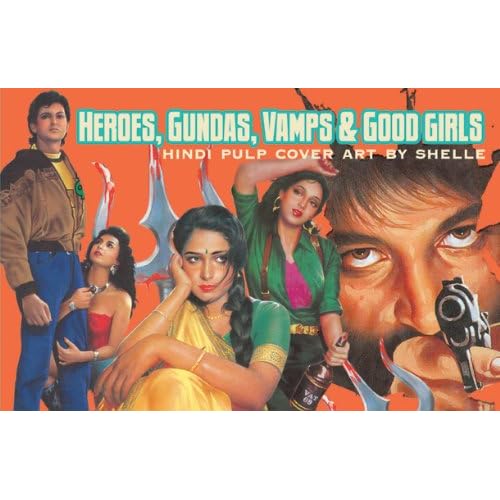
Thursday, December 17, 2009

Anchored to the Past

[The following book review of Farewell Red Mansion, by Sharat Kumar, appeared, with some edits, in the Deccan Herald a while ago]

One problem with reading a translated book is not knowing whether the negatives you find in the book were there in the original or whether they crept in during the translation and editing. It’s a bit like watching a ‘theater-print’ of a movie on a pirated DVD and wondering whether the colours were faded in the original or in the DVD.

The source of some problems in this book, though, is clear. The grammar has typically Indian mistakes – ‘the’s are missing where needed; odd usages of words come in sometimes – ‘would’ instead of ‘will’. There are also places where words that are ‘not quite right’ are used – for example, “it is too late to retrieve your steps”, where ‘retrace’ was the right word. The editing and translation definitely needed to be tighter.

But at points when the storyline goes off track, it isn’t obvious whether the Hindi version had the same issues. Towards the end, an unlikeable character suddenly turns desirable with no reason or rationale – this could have been an issue in the original Hindi as well. The way the climax is presented is a surprise and a letdown. All the little problems leave you wondering what a better-done version of this story would have been like.

The core plot itself is passable. The book opens with Samar coming back to Meerut, to meet his dying father for the last time. Afterwards, he decides to sell off the family house, the 'Lal Kothi' or Red Mansion, and starts looking around for a buyer. The house is on prime property, however, and there are many buyers, each trying their own methods to get their hands on the house. Samar and one other relative, Virendra, are the only morally upright characters here, and both are depicted as being anchored to the past. The story takes you through the corruption and hook-or-crook politics rife in small-town India. The events leave you feeling squeamish, like watching a saas-bahu serial or an accident waiting to happen, and yet wanting to know what happens next.

In parallel is the story of Samar’s father, Samarendra, and his wife Rukmini, set in pre-independence India. Samarendra is a college professor and Rukmini is an activist with the Congress party. The story follows them through three or four years as Rukmini makes fiery speeches, saves prostitutes, goes to jail, praises Gandhiji, and gives birth to Samar. All the characters in this segment are idealistic, good-looking, deeply philosophical, and so on, a complete contrast to Samar’s segment of the story.

The two parallel threads serve to underline the author’s viewpoint that values in India society have degenerated in the past few decades. However, with real people having an annoying tendency of being shades of grey instead of black and white, the corruption described in the book probably existed in all eras, so the pre-independence section seems painfully naïve. Looking at the book from this angle turns it into a literary version of "In our days, things were so much better…!"

One of the annoying things about the book is that every so often, characters launch into unrelated philosophical and historical discussions. This works if it’s well done (such passages are popular in Hindi literature), but in this case the language suddenly turns preachy and the reader is put off.

The original Hindi book, Lal Kothi Alvida, has been the subject of a TV serial, broadcast on Doordarshan. Sharat Kumar himself also directed a film, Duvidha, based on the novel. Besides this book, he has written two management related books, and novels and short story collections in Hindi.

Wednesday, July 22, 2009

"Frodo is still around"

[This essay of mine appeared, slightly edited, in the Deccan Herald a couple of weeks back. In case you clicked on that link, the essay is in the second half of the page]


Frodo is still around

In the 60s, a strange bit of graffiti began appearing on walls in the US. “Frodo Lives!” it said. Frodo was Frodo Baggins, the diminutive hero of The Lord of the Rings, a fantasy novel by J.R.R. Tolkien, which had only just become available in a paperback edition, and so was beginning to reach millions of readers. The characters, the story, and the setting of the novel rapidly won over the hearts of the reading population, and brought Fantasy back into the mainstream. Rings had became a symbol of the times, sometimes identified with the hippie movement and sometimes interpreted as a pro-establishment story.
Rings also gave birth to a whole new subgenre: Tolkienesque Fantasy, with its wizards, elves, dragons, muscular heroes and medieval setting. More properly called Medievalist Fantasy, this has been the most common avatar of Fantasy until recently. Some of the most iconic Medievalist Fantasy books are: The Wheel of Time series by Robert Jordan, the lesser known but much richer Gormenghast series by Mervyn Peake, and the Conan the Barbarian stories by Robert E. Howard. Go to the Fantasy section of your favourite bookstore, and the Medievalist Fantasy titles are easily identified by their fantastic (pardon the pun) covers.
In 1997, the dominance of Medieval Fantasy was seriously challenged by a new book about a schoolboy who finds out he’s a wizard. The Harry Potter books, by J.K. Rowling, were set in London and around, and in a time period that was close to the current day, breaking the expectations from Fantasy books. There have been other such books before – the books of Charles de Lint come to mind – but the Harry Potter books have a magic all their own. They’re an endearing combination of kids’ school stories, adventure, and magic. Harry is neither superhuman, nor extraordinarily intelligent – in fact, some of his friends are smarter and stronger than him – but he’s braver and more determined than the rest. And, Rowling seems to say, that is what really make you a hero. The Harry Potter books were made into hit movies and video games as well, and even today, two years after the series ended, its popularity shows no signs of waning.
The success of the Potter books brought the focus back on two subgenres of Fantasy – Urban Fantasy, which is set in cities and towns similar to the ones we live in, and Coming-of-Age Fantasy, where the protagonists are young folks. There have since been dozens of books in these genres, more so in the latter. The Artemis Fowl series, a more action-oriented series with magical elements, is a good example.
Besides prose fiction, comics and movies have had their own high points in the Fantasy genre. Neil Gaiman, now better known as a prose writer, hit the big time with his comic series, Sandman, which was about the King of Dreams and his dark, quirky, world populated by beings from mythology and overlapping with our own. Unlike most other comics, this series had a proper beginning and end, and the characters were better etched than in most novels. In Hollywood movies, most fantasy films are based on books or existing concepts – The Wizard of Oz and The Lord of the Rings being good examples. But Japanese cinema, and especially Anime, has had a long tradition of original fantasy films, with Spirited Away and Princess Mononoke, both by Hayao Miyazaki, being well known examples. Indian movies have had their own share of Fantasy, with movies ranging from Hatim Tai and Ali Baba aur Chalis Chor, to Ajooba and Jajantaram Mamantaram.
In India, the development of Fantasy writing as a genre has taken a different path, with different milestones. The first recognized prose work in modern Hindi, Chandrakanta, by Babu Devkinandan Khatri, was a fantasy. It was written in short chapters, called bayaan, which were published individually and distributed to waiting fans. Such was its influence that people learnt Hindi just to be able to read this book. After completing Chandrakanta, Khatri wrote several sequels, starting with the multi-volume Chandrakanta Santati.
Chandrakanta was set in a world of kings and princesses, and featured concepts that were borrowed both from Indian tales and Persian folklore. For example, it talked of a magical spell called Tilism, which was a kind of trap door world. Once it is entered, there is no exit until a puzzle or trick is solved, or else, until a specific person comes into the Tilism. Interestingly, one of the most popular Urdu fantasy books is the Tilism-e-Hoshruba, which was a sprawling multi-volume opus originally written by Muhammad Husain ‘Jah’ and Ahmed Husain Qamar in the late 1870s and 1880s.
Of late, there have been several writers in India writing in the Fantasy tradition. Samit Basu, with his Gameworld Trilogy, is probably the best known. But there are many others too, such as Appupen, who’s ready to release a fantasy graphic novel named Moonward in next month. Writers who are reinterpreting mythical tales, such as Devdutt Pattanaik, with his The Pregnant King, could also be said to be using Fantasy tropes, although in India, this is a thin distinction.
In many forms, in many media, Fantasy has been with us for a long time. Going by the way it has always reinvented itself to remain fresh, it probably will remain with us in the future as well.


---------------


Five must-read Fantasy series:
1. The Lord of the Rings, by J.R.R. Tolkien. What, you haven’t read it yet?
2. The Harry Potter series, by J. K. Rowling. The series that brought children to books again.
3. The Sandman series, by Neil Gaiman. They’re graphic novels, sure. But the depth of Gaiman’s writing makes this one of the richest fantasy worlds ever.
4. Chandrakanta and its sequels, by Babu Devkinandan Khatri. It isn’t just one book, there are three multi-volume sequels as well. Ignore the soap-operatic Doordarshan serial, and read this amazing series in the original Hindi.
5. Discworld, by Terry Pratchett. A twenty-plus volume comic fantasy series set on a flat world that’s mounted on the back of a turtle. Oh, and Death himself is a major character in this series– he rides a horse named Binkie.